
close
Choose Your Site
Global
Social Media

The Fundamental Distinction Between Nano Calcium Carbonate and Regular Calcium Carbonate
Functional Advantages of Nano Calcium Carbonate in Industrial Applications
Comparative Performance in Plastics, Rubber, Paints, and Coatings
Cost, Limitations, and Considerations When Choosing Nano Calcium Carbonate
Nano Calcium Carbonate has emerged as one of the most versatile functional fillers in modern manufacturing, offering performance upgrades that regular calcium carbonate cannot deliver. Its development represents a shift from bulk mineral fillers toward engineered nano-materials that modify product behavior at a micro-structural level. The core of this topic revolves around understanding how Nano Calcium Carbonate differs from regular calcium carbonate—not merely in size, but in functionality, processing behavior, material compatibility, and end-use performance. By examining these differences in depth, manufacturers, formulators, and researchers can identify where Nano Calcium Carbonate provides tangible advantages and where traditional versions still hold value.
At its core, the difference between Nano Calcium Carbonate and regular calcium carbonate lies in particle size engineering. Traditional calcium carbonate usually falls within the micrometer scale, whereas Nano Calcium Carbonate ranges from 20 nm to a few hundred nanometers. This transition from micro-scale to nano-scale dramatically alters the material’s surface area, reactivity, and compatibility with host matrices. Nano Calcium Carbonate is not simply ground to smaller sizes; it is produced using controlled precipitation techniques that create uniform particles with specific morphologies such as spherical, cubic, spindle-shaped, or chain-structured forms. These tailored structures allow Nano Calcium Carbonate to perform roles beyond simple bulk filling, acting instead as a functional performance enhancer in various formulations.
Another major distinction involves surface modification. While regular calcium carbonate is typically used in raw form, Nano Calcium Carbonate is often coated or chemically treated to ensure uniform dispersion, reduce agglomeration, and improve interaction with polymers or resins. These differences collectively transform Nano Calcium Carbonate from a commodity filler into a highly adaptable engineered material suitable for advanced applications requiring precision, consistency, and high performance.
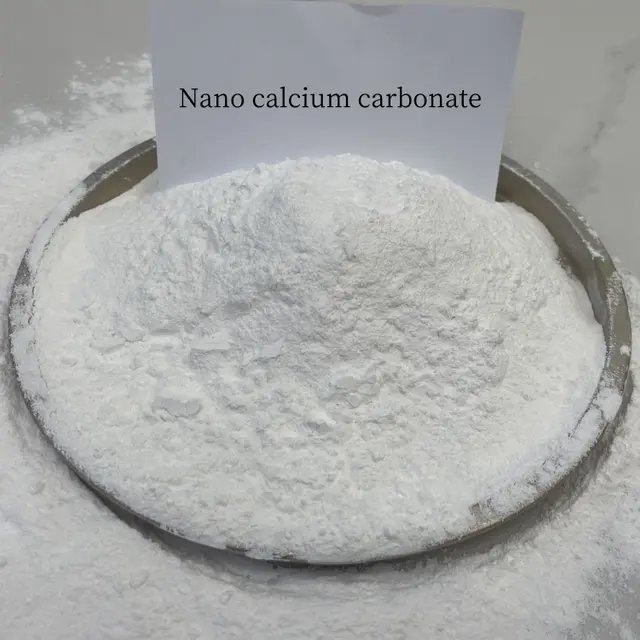
The reduction of particle size from microns to nanometers significantly influences how each material behaves inside formulations. Nano Calcium Carbonate’s high specific surface area improves bonding with polymer chains, enhances reinforcement, and facilitates more stable dispersion. In contrast, regular calcium carbonate tends to sit within a matrix as inert filler particles, providing volume but offering minimal functional reinforcement. The smaller size of the nano-variant enables it to fit between polymer chains more effectively, increasing packing density and contributing to improved mechanical properties such as tensile strength, impact resistance, and dimensional stability.
In applications like plastics or rubber, this particle size effect becomes particularly crucial. Nano Calcium Carbonate acts at the microscopic interface, changing how forces are distributed through a material under stress. This leads to products that are stronger, more flexible, or more resistant to deformation. Additionally, the ultra-fine particle distribution enhances surface smoothness, providing cosmetic and textural improvements in coatings, inks, and papers where visual quality is essential. These performance gains stem directly from the reduced particle size and should not be confused with simple fineness improvements found in high-grade micron calcium carbonates.
Structural uniformity sets Nano Calcium Carbonate apart. Regular calcium carbonate often shows broad particle size distribution and irregular shapes due to mining and grinding processes. Nano Calcium Carbonate, by contrast, is synthesized under controlled conditions that allow precise manipulation of particle morphology. This uniformity reduces voids and inconsistencies within the host material, directly improving mechanical stability and product consistency.
Surface chemistry also plays a crucial role. Nano Calcium Carbonate is frequently treated with fatty acids, silanes, or other coupling agents to improve compatibility with hydrophobic polymers. This treatment minimizes agglomeration—an inherent challenge when dealing with nano-materials—ensuring that particles remain evenly distributed during processing. Regular calcium carbonate, which is typically untreated or only lightly coated, lacks this level of engineered surface functionality. The result is that Nano Calcium Carbonate interacts more effectively at molecular interfaces, allowing it to serve as a functional additive rather than merely a filler.
Table 1: Comparison of Key Structural Properties
| Property | Nano Calcium Carbonate | Regular Calcium Carbonate |
|---|---|---|
| Particle Size | 20–200 nm | 1–10 μm |
| Shape Control | High (spherical, cubic, etc.) | Low / irregular |
| Surface Modification | Common and specialized | Minimal |
| Surface Area | Very high | Moderate |
| Agglomeration Risk | Higher but controlled | Lower but less engineered |
Nano Calcium Carbonate’s engineered properties translate into tangible performance advantages across several industries. In plastics, it enhances mechanical strength and reduces shrinkage without significantly increasing weight. In rubber, it improves elasticity, tear strength, and abrasion resistance. Paints and coatings benefit from improved opacity, whiteness, and surface smoothness due to its light-scattering capabilities at the nano scale. These advantages stem from the particle’s ability to interact at a molecular level with surrounding materials, modifying functional characteristics rather than simply occupying space.
Furthermore, Nano Calcium Carbonate provides significant rheological benefits. In coatings or inks, its uniformity prevents sedimentation and maintains consistent viscosity during storage and application. In adhesives, the increased surface area enhances bonding and contributes to improved shear strength. These multi-functional properties make Nano Calcium Carbonate a preferred choice for manufacturers seeking more than simple cost reduction. It allows formulators to fine-tune product characteristics, creating materials that combine light weight, strength, flexibility, and surface refinement in ways that regular calcium carbonate cannot achieve.
The most visible differences between Nano Calcium Carbonate and regular calcium carbonate become apparent in real industrial performance. In plastics such as PVC, polypropylene, or polyethylene, Nano Calcium Carbonate acts as a nucleating agent, promoting faster crystallization and improving dimensional stability. Regular calcium carbonate can provide stiffness but often reduces impact strength, while the nano-variant enhances both rigidity and toughness simultaneously. This dual improvement is a major factor in the growing adoption of Nano Calcium Carbonate for lightweight, high-performance materials.
Rubber applications also highlight these distinctions. Nano Calcium Carbonate improves filler distribution, resulting in stronger, more uniform rubber compounds. Regular calcium carbonate can weaken matrices when used in high volumes, while Nano Calcium Carbonate performs effectively even at lower loadings, offering higher reinforcement efficiency.
Table 2: Performance Comparison in Industrial Use
| Application | Nano Calcium Carbonate Benefits | Regular CaCO₃ Benefits |
|---|---|---|
| Plastics | Higher impact strength, reduced shrinkage, improved clarity | Cost-effective bulk filler |
| Rubber | Better abrasion resistance, improved elasticity | Basic volume addition |
| Paints/Coatings | Enhanced smoothness and opacity, improved dispersion | Provides whiteness and opacity |
| Adhesives | Higher bonding strength | Economical thickening |
These comparisons demonstrate that Nano Calcium Carbonate is not simply a finer version of traditional calcium carbonate; its engineered behavior produces fundamentally different performance outcomes, especially in high-value, precision-oriented applications.
Purity is another area where Nano Calcium Carbonate generally outperforms regular calcium carbonate. Because it is produced synthetically, impurities such as heavy metals, silica, or clay are significantly lower. This purity ensures consistent quality, which is particularly important in applications like pharmaceuticals, food packaging materials, or high-gloss coatings where contaminants could compromise safety or appearance.
Dispersion characteristics also differ dramatically. Nano Calcium Carbonate, when properly treated, disperses uniformly even in hydrophobic systems. Its dispersion strength reduces micro-defects and prevents uneven distribution that can weaken physical properties. Regular calcium carbonate, with its larger particle size and lower surface activity, often requires stronger mechanical mixing and can still form clusters.
Processing behavior—an essential consideration for manufacturers—also favors Nano Calcium Carbonate. It lowers melt viscosity in plastics, enabling faster extrusion rates and reducing energy consumption. It improves flexibility in rubber processing and contributes to smoother film formation in coatings. These behavior differences stem from Nano Calcium Carbonate’s engineered surface interactions and controlled particle design.
Although Nano Calcium Carbonate offers clear technical benefits, it is essential to consider cost, compatibility, and formulation requirements before making a selection. Nano Calcium Carbonate is more expensive due to its synthetic production process and surface treatment. Therefore, its use must be strategically targeted to applications where performance improvements justify the investment. For low-value or high-volume products where cost per kilogram is critical, regular calcium carbonate may remain the preferred option.
Additionally, Nano Calcium Carbonate requires proper dispersion and handling to avoid agglomeration. Manufacturers unfamiliar with nano-material processing may need technical adjustments such as improved mixing equipment or pre-dispersed masterbatch forms. It is also important to evaluate regulatory requirements—especially in food-contact or pharmaceutical applications—where nano-materials may face stricter scrutiny. Despite these considerations, the performance advantages often outweigh the challenges, particularly in industries where material performance, product lifespan, and quality differentiation are key competitive factors.
Nano Calcium Carbonate differs from regular calcium carbonate in ways that extend far beyond particle size. Its engineered structure, controlled morphology, enhanced surface chemistry, and superior dispersion capabilities transform it into a functional performance enhancer rather than simply a filler. These differences create measurable improvements in strength, durability, smoothness, opacity, and processing efficiency across plastics, rubber, coatings, adhesives, and more. While cost and formulation considerations must be evaluated, Nano Calcium Carbonate provides significant value in applications demanding high performance and precision. Understanding these distinctions allows manufacturers to optimize materials, reduce defects, and innovate beyond the limitations of traditional fillers.
1. Is Nano Calcium Carbonate stronger than regular calcium carbonate?
Yes. Due to its nano-scale size and higher surface area, Nano Calcium Carbonate enhances reinforcement, improving impact strength, tensile strength, and durability in various materials.
2. Does Nano Calcium Carbonate replace regular calcium carbonate entirely?
Not necessarily. Regular calcium carbonate remains a cost-effective choice for basic filling needs, while Nano Calcium Carbonate is best used for high-performance or specialty applications.
3. Why is Nano Calcium Carbonate more expensive?
Its production involves controlled precipitation, surface treatments, and strict purity controls, making it more technically advanced and costly than mined calcium carbonate.
4. Can Nano Calcium Carbonate improve surface quality?
Yes. It enhances smoothness, gloss, opacity, and color uniformity in coatings, plastics, and papers due to its fine particle size and controlled dispersion.
5. Is Nano Calcium Carbonate safe to use?
When properly handled and formulated, it is considered safe for industrial use. However, specific applications—especially food or pharma—must follow relevant regulatory guidelines.


