close
Choose Your Site
Global
Social Media

Views: 0 Author: Site Editor Publish Time: 2026-05-28 Origin: Site
Confusion around limestone, lime, quicklime, and calcium hydroxide often starts when a product label uses the word “lime” without showing the chemical formula. For buyers, builders, water treatment operators, or chemical processors, that small wording difference can affect performance, safety, and cost. Calcium hydroxide is not limestone, although it is produced from limestone through industrial processing. Understanding the calcium hydroxide limestone relationship helps clarify when calcium carbonate is enough, when hydrated lime is required, and what to check before choosing High Purity Calcium Hydroxide Powder.
Calcium hydroxide is not limestone. Limestone is mainly calcium carbonate, written as CaCO₃, while calcium hydroxide is Ca(OH)₂, a processed alkaline compound created after limestone has been calcined and the resulting quicklime has been slaked with water. The calcium hydroxide limestone relationship is therefore a production relationship, not an identity relationship.
Both materials contain calcium, but the rest of their chemistry changes how they behave. Calcium carbonate is relatively stable and slow-reacting, which makes limestone useful as a mineral source, filler, aggregate, or agricultural amendment. Calcium hydroxide contains hydroxide ions, which give it higher alkalinity and make it more suitable for fast pH adjustment, acid neutralization, water treatment, and chemical processing.
The practical difference becomes clear when a specification requires a formula rather than a trade name. If a process calls for Ca(OH)₂, crushed limestone will usually react too slowly and may fail to reach the desired pH or neutralization efficiency. If a process only needs CaCO₃ as a mineral filler, calcium hydroxide may be unnecessarily caustic, more expensive to handle, and chemically unsuitable.
Limestone vs Calcium Hydroxide
Feature | Limestone | Calcium Hydroxide |
Chemical formula | CaCO₃ | Ca(OH)₂ |
Chemical name | Calcium carbonate | Calcium hydroxide |
Common names | Limestone, chalk, agricultural lime | Hydrated lime, slaked lime, builders’ lime, pickling lime |
Typical form | Rock, crushed stone, fine powder | White powder, paste, lime slurry |
Reactivity | Lower | Higher alkaline reactivity |
Main function | Mineral filler, soil amendment, raw material | pH control, neutralization, water treatment, chemical processing |
Can replace the other? | Not usually | Not usually |
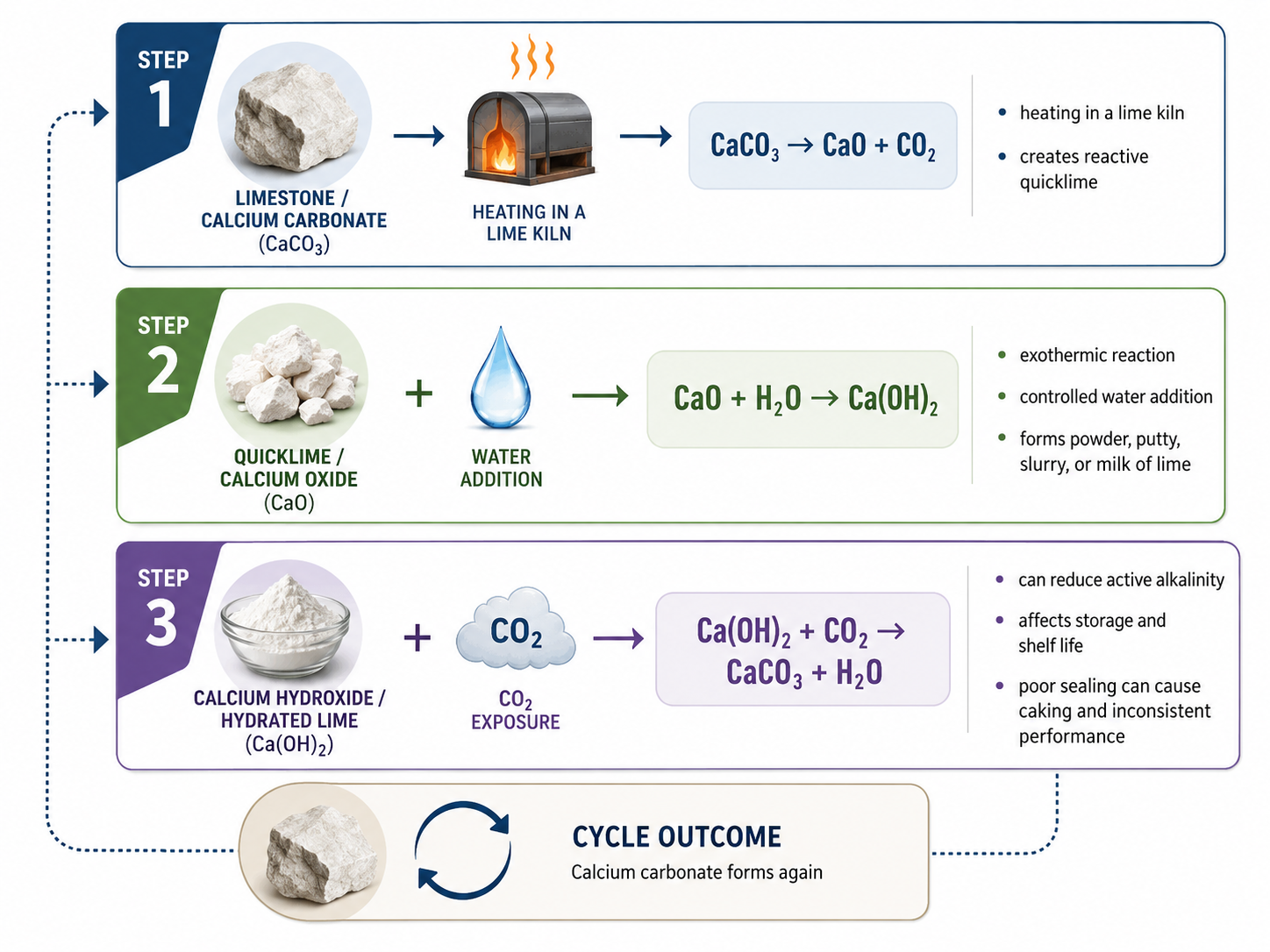
The lime cycle explains why calcium hydroxide is related to limestone but not the same material. Limestone starts as calcium carbonate, then becomes quicklime through heating, and finally becomes calcium hydroxide after water is added. Each step changes the material’s formula, reactivity, and handling requirements.
Calcination is the high-temperature stage that converts limestone into quicklime. Limestone is mainly calcium carbonate, CaCO₃. When it is heated in a lime kiln, calcium carbonate breaks down into calcium oxide and carbon dioxide.
Reaction: CaCO₃ → CaO + CO₂
This step is important because it changes limestone from a stable mineral into quicklime, a much more reactive material. In the calcium hydroxide limestone production route, quicklime is the necessary intermediate. Without this step, limestone cannot simply become calcium hydroxide by grinding, washing, or adding water.
Several production factors affect quicklime quality:
● Kiln temperature: insufficient heat may leave unreacted calcium carbonate.
● Heating time: poor residence time can cause uneven calcination.
● Stone size: large or uneven stones may not heat consistently.
● Limestone purity: impurities can affect final reactivity and whiteness.
● Fuel and process control: unstable firing can create inconsistent quicklime.
● Overburning or underburning: both can reduce hydration performance.
For industrial buyers, this stage matters because quicklime quality affects the calcium hydroxide made later. Poor calcination may lead to lower reactivity, incomplete hydration, coarse particles, or unstable product performance. That is why High Purity Calcium Hydroxide Powder depends not only on the final slaking process, but also on the quality of the limestone and calcination control.
Slaking happens when water is added to quicklime. The reaction produces calcium hydroxide and releases heat, so industrial slaking requires controlled water addition, mixing, and temperature management.
Reaction: CaO + H₂O → Ca(OH)₂
This is the stage where the calcium hydroxide limestone pathway becomes commercially useful. Calcium oxide is converted into hydrated lime, also called slaked lime or calcium hydroxide. Depending on the amount of water used and the processing method, the final material can take several forms:
● Dry hydrated lime powder: suitable for packaging, transport, and dry feeding systems.
● Lime putty: used where plasticity and workability matter.
● Lime slurry: useful for controlled dosing in water treatment or neutralization.
● Milk of lime: a suspension used in many wet industrial processes.
For High Purity Calcium Hydroxide Powder, slaking directly affects quality. Buyers should look beyond the name “hydrated lime” and check whether the product has stable chemical and physical indicators.
Important technical indicators include:
● Ca(OH)₂ content
● Available alkalinity
● Particle size distribution
● Moisture level
● Acid-insoluble matter
● Whiteness
● Batch consistency
● COA and SDS documentation
Well-controlled slaking helps produce powder with better dispersion, more consistent reaction speed, and fewer coarse or unreacted particles. Poor slaking can create material that looks acceptable but performs inconsistently in slurry preparation, pH adjustment, or chemical processing.
Carbonation happens when calcium hydroxide reacts with carbon dioxide in the air. This reaction can convert part of Ca(OH)₂ back into calcium carbonate, which is the same main compound found in limestone.
Reaction: Ca(OH)₂ + CO₂ → CaCO₃ + H₂O
This reaction is useful in lime mortar, limewash, and some curing processes because calcium carbonate formation helps the material harden over time. However, for stored powder or slurry, carbonation can become a quality problem. If calcium hydroxide is exposed to air for too long, the active alkalinity may decrease.
Common quality risks include:
● Lower reaction efficiency
● Shorter usable shelf life
● Caking during storage
● Poor flowability
● Inconsistent dosing
● Reduced pH adjustment performance
● Partial loss of active Ca(OH)₂
This is why packaging and storage conditions matter. A product may start as high-purity calcium hydroxide, but poor sealing, humidity, or long exposure after opening can reduce its effective performance. For B2B buyers, the calcium hydroxide limestone relationship is not only about chemical origin. It also explains why storage stability, moisture control, and CO₂ protection should be part of product evaluation.
Limestone, quicklime, and calcium hydroxide represent different stages of the lime cycle. Limestone is the starting mineral, quicklime is the calcined oxide, and calcium hydroxide is the hydrated alkaline product. The calcium hydroxide limestone issue becomes risky when a buyer treats these stages as equivalent because they all appear under the broad “lime” family.
Each stage serves a different chemical role. Calcium carbonate supplies mineral calcium and reacts slowly under many conditions. Calcium oxide reacts aggressively with water, while calcium hydroxide provides hydroxide alkalinity in a more usable powder, paste, or slurry form.
A process designed for calcium hydroxide usually expects Ca(OH)₂ to deliver a high-pH response. Replacing it with limestone may not provide enough alkalinity within the required contact time. Conversely, a process designed for limestone may not tolerate the stronger alkalinity, dust behavior, or handling controls associated with calcium hydroxide.
This is why calcium hydroxide limestone should not be framed as a simple “which is better” question. The correct material depends on whether the process needs calcium carbonate, calcium oxide, or calcium hydroxide. Formula, reaction speed, and end-use conditions should decide the purchase.
The main performance gap is reactivity. Limestone is less reactive because calcium carbonate is chemically more stable and only slightly reactive in many neutral or alkaline systems. Calcium hydroxide has stronger alkaline behavior because it can release hydroxide ions into water, making it more effective for pH control and acid neutralization.
The calcium hydroxide limestone comparison should therefore focus on reaction speed, alkalinity, and process outcome rather than product name alone. A water treatment plant may choose calcium hydroxide because dosage response needs to be predictable. A filler or mineral application may choose limestone because high alkalinity is not required.
Particle behavior also matters. Limestone powder may work as a stable mineral filler, while calcium hydroxide powder must be evaluated for fineness, dusting, dispersion, and slurry stability. In a lime slurry system, calcium hydroxide behaves as a suspension rather than a fully dissolved liquid, so mixing and dosing design affect performance.
Factor | Limestone | Calcium Hydroxide |
Main compound | Calcium carbonate | Calcium hydroxide |
Lime cycle stage | Raw material | Hydrated lime product |
Alkalinity | Lower | Higher |
Reaction speed | Slower | Faster |
Best role | Mineral source or filler | Alkaline reagent |
Replacement risk | May react too slowly | May be too alkaline or reactive |
Calcium hydroxide is more reactive than limestone, so its performance depends heavily on how it is stored and handled. The main risk is that Ca(OH)₂ can absorb carbon dioxide and moisture from the air. When this happens, part of the material may convert back into calcium carbonate, while moisture can cause caking, poor flowability, and uneven dosing. This is why the calcium hydroxide limestone difference is not only a chemistry issue, but also a storage and performance issue.
For High Purity Calcium Hydroxide Powder, poor storage can reduce the value of the product even before it is used. A powder with high Ca(OH)₂ content may perform inconsistently if it is exposed to humid air, stored in damaged bags, or kept too long after opening. Buyers should pay attention to a few practical controls:
● Keep packaging sealed until use.
● Store bags in a dry, ventilated warehouse.
● Avoid long exposure to air after opening.
● Use first-in, first-out inventory management.
● Check COA, batch number, packaging condition, and shelf-life information.
Handling problems become more visible when calcium hydroxide is used as lime slurry. Because lime slurry is a suspension rather than a fully dissolved liquid, solids can settle without proper mixing. Settling often leads to uneven concentration, while scale buildup can narrow pipes, affect dosing accuracy, and increase cleaning downtime. A reliable slurry system should include controlled concentration, suitable tank design, regular agitation, and scheduled cleaning.
Safety should also match the product form. Dry powder creates dust risk, slurry creates splash and slip risk, and onsite slaking creates heat risk. Calcium hydroxide is less reactive than quicklime, but it is still strongly alkaline and should not be handled like ordinary limestone. Basic protection should include goggles, gloves, ventilation, dust control, and clear procedures for spills or contact with acids.
The calcium hydroxide limestone relationship is simple once the formula is clear: limestone is mainly calcium carbonate, while calcium hydroxide is a processed hydrated lime made through calcination and slaking. They are connected in the lime cycle, but they should not be treated as interchangeable materials. Choosing correctly depends on reactivity, alkalinity, particle behavior, storage conditions, and application requirements. For buyers who need consistent High Purity Calcium Hydroxide Powder, Changshu Hongyu Calcium Co., Ltd. provides calcium hydroxide products that support reliable pH control, neutralization, and industrial processing with clearer material selection.
A: No. Limestone is mainly calcium carbonate, CaCO₃, while calcium hydroxide is Ca(OH)₂. They are related through the lime cycle but are not the same material.
A: Limestone is a natural mineral or rock with lower reactivity. Calcium hydroxide is a processed alkaline compound used for pH control, neutralization, and industrial chemical reactions.
A: Yes. Calcium hydroxide is commonly called hydrated lime or slaked lime. These names usually refer to the same compound, Ca(OH)₂.
A: Limestone is heated to produce quicklime, or calcium oxide. Water is then added to quicklime through slaking, forming calcium hydroxide.
A: Not usually. Limestone reacts more slowly and has lower alkalinity. It may not work where fast pH adjustment or strong neutralization is required.
A: Buyers should check Ca(OH)₂ content, available lime, particle size, moisture level, insoluble matter, heavy metals, COA, and SDS documentation.