close
Choose Your Site
Global
Social Media

Views: 0 Author: Site Editor Publish Time: 2026-05-24 Origin: Site
Intensive farming and heavy, persistent rainfall silently steal crop profitability. They actively leach vital base cations from the earth. This relentless natural process quickly replaces healthy soil components. Yield-suppressing hydrogen and aluminum ions take their place. This mounting soil acidity acts as an invisible barrier in modern agriculture. Strongly acidic soil renders expensive commercial fertilizers utterly useless. It aggressively locks up essential macronutrients. Farm operators inevitably face diminishing returns. Crop roots simply cannot access what they need to thrive. To combat this widespread challenge, we must explore high-efficiency solutions. Precision tools designed for targeted soil pH adjustment offer immediate relief. We will examine exactly how calcium hydroxide and hydrated lime contrast against slower-acting liming materials. You will systematically learn practical implementation strategies. We will also cover vital efficiency metrics and proven risk management tactics. These methods are designed to rigorously protect your seasonal crop yields.
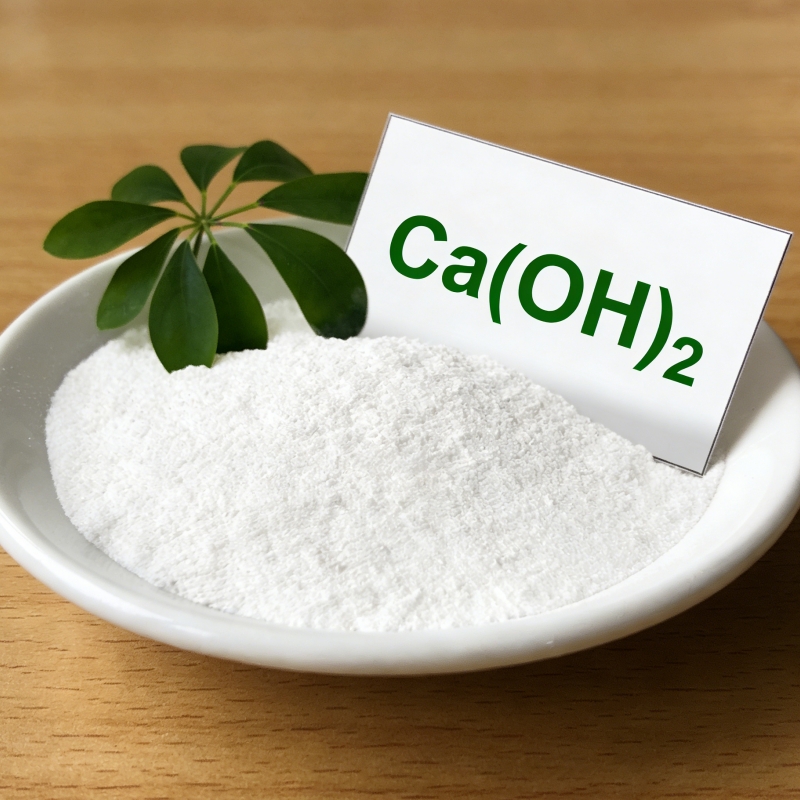
Calcium hydroxide possesses a Calcium Carbonate Equivalent (CCE) of 120–135, making it significantly more potent by weight than standard agricultural lime.
It provides rapid soil pH adjustment, immediately neutralizing aluminum and manganese toxicity in the root zone.
Proper application requires strategic timing to avoid nitrogen volatilization—it must not be applied simultaneously with ammonium-based fertilizers.
Strategic deployment often involves combining rapid-acting hydrated lime with slow-release calcium carbonate for sustained soil health.
Diagnosing acidic soil requires understanding its primary drivers. Long-term use of nitrogen fertilizers heavily impacts soil chemistry. Urea and ammonium sulfate introduce hydrogen ions during the nitrification process. Heavy rainfall compounds this issue dramatically. Water washes away natural calcium and magnesium reserves. Soil pH inevitably plummets. This creates a hostile environment for commercial crops.
A critical toxicity threshold exists around a pH of 5.5. When soil drops below this level, clay minerals begin to dissolve. This dissolution releases highly soluble aluminum (Al3+) and manganese (Mn2+) ions directly into the soil solution. These toxic ions aggressively attack plant systems. Root growth stunts immediately. Root tips become brown, thick, and brittle. Foliar chlorosis soon follows. Leaves turn pale or yellow, crippling the plant's photosynthetic capacity.
Acidic environments also cause severe nutrient lock-up. Free aluminum heavily binds available phosphorus. It forms insoluble aluminum phosphate compounds. Plants slowly starve. Agribusinesses often respond by over-applying phosphorus fertilizers. This strategy yields steeply diminishing returns. You end up wasting chemical inputs. Your operational budgets drain while crop yields remain poor.
To fix this, we must examine the baseline calcium requirement. Optimal soil structure typically demands a dominant presence of calcium. A healthy cation exchange complex requires roughly 65% calcium saturation. This baseline maintains vital microbial health. Beneficial bacteria rely on this calcium to break down organic matter. Adequate calcium also ensures efficient nutrient conversion across the entire root zone.
Agronomists choose from several mineral inputs to manage field conditions. Understanding the chemical mechanics of each option prevents costly misapplications. We categorize these inputs based on their reaction speed and neutralizing power. Calcium hydroxide stands apart as a specialized tool.
The chemical mechanism behind this product guarantees rapid results. Calcium hydroxide dissociates instantly into calcium (Ca2+) and hydroxide (OH-) ions in moist soil. The hydroxide ions neutralize free hydrogen acid immediately. Meanwhile, the calcium ions aggressively displace toxic aluminum on the cation exchange complex. It serves as an elite soil conditioner for urgent interventions.
You should deploy it for specific best use cases. Emergency pH correction requires its speed. It suppresses soil-borne diseases rapidly. Sudden alkaline spikes deter fungal pathogens effectively. Agronomists heavily rely on it when preparing fields for highly sensitive, high-value cash crops.
Calcium carbonate, commonly known as agricultural lime, operates on a completely different timeline. Its primary mechanism involves slow dissolution. It provides long-term acid buffering rather than instant neutralization. It requires months to activate fully.
Its best use case centers on routine field maintenance. Farm managers frequently combine it strategically. They blend rapid-acting hydrated lime with slow-release calcium carbonate. This dual strategy balances immediate pH correction against reliable, multi-year stability.
Gypsum operates through a completely distinct mechanism. It readily provides soluble calcium to the soil. It also effectively displaces excess sodium in saline environments. However, its sulfate ions do not absorb hydrogen.
You must understand one key distinction. Gypsum vastly improves physical soil structure. It breaks up heavy clay. However, it absolutely does not raise soil pH. You cannot cure field acidity using gypsum alone.
Input Material | Primary Chemical Reaction | Reaction Speed | Impact on Soil pH |
|---|---|---|---|
Calcium Hydroxide | Releases OH- to neutralize H+ instantly | Extremely Fast (Weeks) | Rapidly Elevates pH |
Calcium Carbonate | Carbonate slowly buffers H+ over time | Slow (Months to Years) | Gradually Elevates pH |
Calcium Sulfate | Releases Ca2+ but does not buffer H+ | Moderate | Neutral (No pH Change) |
Agronomists measure neutralizing power using a strict industry standard. We call this metric the Calcium Carbonate Equivalent (CCE). This standardized framework allows buyers to compare different liming materials accurately. It removes marketing claims from the equation. You rely entirely on proven chemical science.
We establish the baseline using pure calcium carbonate. Laboratories index this pure baseline at a CCE of precisely 100. All other soil amendments measure their strength against this fixed number.
The calcium hydroxide advantage becomes obvious here. High-quality hydrated lime highlights a potent CCE range of 120 to 135. It possesses significantly more neutralizing power per pound than standard limestone. Its refined chemical structure drives this intense reactivity.
This metric translates directly into massive operational savings. You only need approximately 0.74 tons of calcium hydroxide to achieve your goal. This smaller volume matches the exact neutralizing outcome of one full ton of standard limestone. This sheer efficiency shrinks your logistical footprint immediately. You pay for fewer delivery trucks. You consume less diesel fuel. You drastically reduce field application labor.
Pure Limestone | CCE 100 |
Agricultural Lime | CCE 85-90 |
Calcium Hydroxide | CCE 120-135 |
*Wider bars indicate higher neutralizing efficiency per applied ton.
Precision agriculture demands strict protocols. You cannot apply high-potency inputs blindly. Applying strong alkaline materials requires disciplined, data-driven management. Following a structured implementation pathway guarantees safety. It also maximizes your return on investment.
Pre-Application Testing: You must mandate comprehensive baseline soil testing. Map your current field pH accurately. Define your target pH goal. You must also measure the Cation Exchange Capacity (CEC). Heavy clay soils boast a high CEC. They require significantly more tonnage to shift their pH. Sandy soils feature a low CEC. They demand much lighter application rates.
Application Depth: We highly recommend uniform mechanical incorporation. You should till the amendment into the earth. Target a depth of at least 6 inches (15cm). This practice ensures you adequately treat the active root zone. If you choose to till deeper, you must adjust application rates proportionally. Deeper integration requires more material.
Timing Strategies: You must apply these materials optimally. Aim for 3 to 6 months prior to your planting date. The aggressive chemical reaction needs time to stabilize safely. Always apply prior to expected rainfall. Natural soil moisture facilitates the rapid dissociation of hydroxide ions. Without moisture, the material sits dormant.
Maintenance Cycles: You must acknowledge natural agronomic drift. Soil pH naturally drifts back down over time. Heavy rains and fertilizer applications guarantee this regression. Budget your operations for regular reassessment. Plan for potential reapplication cycles every three years.
High-efficiency tools carry inherent risks. Farm operators must exercise caution. Calcium hydroxide demands rigorous management. Improper application timing destroys fertilizer investments. Excessive application rates severely damage plant health. You must navigate these hazards carefully.
We explicitly warn against simultaneous applications. Do not apply calcium hydroxide alongside ammonium-based fertilizers. Keep it far away from fresh manure applications. You must separate these events by several weeks.
The chemistry dictates this strict rule. Calcium hydroxide introduces strong, sudden alkalinity. Ammonium exists as a weak base. The intense alkaline spike forces the ammonium to convert rapidly. It turns into toxic ammonia gas. This gas volatilizes directly into the atmosphere. You suffer severe nitrogen loss. You literally watch your expensive fertilizer investment evaporate.
You face serious hazards when you push pH too high, too fast. We call this phenomenon "overliming". Precision testing prevents this common mistake. Applying arbitrary amounts guarantees trouble.
Alkaline extremes lock up critical soil micronutrients. When pH spikes past 7.5, manganese, copper, zinc, phosphorus, and boron become insoluble. Crop roots cannot absorb them. You inadvertently create severe secondary deficiencies. Leaves turn white or yellow. Plant development halts. Overliming causes problems that require years to fix.
Your soil hosts a delicate, living ecosystem. Trillions of beneficial microbes process organic matter constantly. They thrive in stable environments. Drastic, overnight pH shifts temporarily stun these established soil microbiomes.
This biological shock halts nutrient cycling. The microbial workforce essentially pauses. This reality reinforces the absolute need for calculated application rates. Rely entirely on data-driven metrics. Gradual, well-planned applications protect your invisible workforce.
You must treat calcium hydroxide as a precision agronomic tool. It is not a generic, bulk agricultural input. It delivers rapid, high-efficiency adjustments directly to the root zone. You deploy it to solve severe toxicity issues fast.
We highly recommend integrating it carefully into your crop management plans. Ensure you observe the following action steps to guarantee success:
Acknowledge its high CCE power. This high rating lowers overall volume requirements but demands total accuracy.
Enforce strict adherence to comprehensive soil testing protocols before spreading any material.
Separate alkaline applications from nitrogen fertilizer schedules strictly to prevent costly ammonia gas volatilization.
Execute updated CEC testing across your acreage immediately. Establish clear baselines.
Consult with your agronomic suppliers soon. Build a smart, dual-strategy liming program combining both rapid hydroxides and slow-release carbonates.
A: It begins reacting almost immediately in the presence of soil moisture. It elevates pH levels efficiently in a matter of weeks. Conversely, standard agricultural lime dissolves very slowly. It can take many months or even years to fully activate and shift soil chemistry.
A: No. The high alkalinity of calcium hydroxide will cause a destructive chemical reaction. This reaction quickly releases valuable nitrogen as volatile ammonia gas. You will completely waste your expensive fertilizer investment. Always separate these chemical applications by at least a few weeks.
A: Indirectly, yes. The sudden, sharp increase in localized alkalinity and available calcium can heavily suppress certain soil-borne fungal diseases. It creates a temporarily hostile micro-environment. This sudden shift effectively deters specific insect pests and disrupts fungal pathogen life cycles.
A: If your primary agronomic goal involves adjusting soil pH to cure toxicity, you must use a hydroxide or carbonate. Gypsum provides excellent soluble calcium. It improves soil structure wonderfully. However, its chemical makeup will not neutralize existing soil acids or elevate pH.